
THE BUILD: TEAM UPDATES AND BUILD PROGRESS
Welcome to The Build, where we post team updates, build progress, race prep, and the occasional mechanical crisis dressed up as “learning.” This is the running story of Black Flag Racing turning a perfectly innocent Honda Accord into an endurance car through fabrication, stubbornness, questionable judgment, and just enough engineering to keep it interesting. If you enjoy fast updates, race-car chaos, and watching bad ideas occasionally become great ones, you’re in the right place.

The Engine Is Dead. Long Live the “New” One.
After New Orleans, we learned two things. First, a K24 can apparently convert itself from “engine” to “evidence” with very little notice. Second, nothing strengthens team morale quite like standing in the rain, staring at a hole in the block large enough to make you question your life choices and your parts budget at the same time. So naturally, we responded the only reasonable way possible: by trying to source another K24A2, clearing the schedule, and preparing to do it all again before South Carolina. At Black Flag Racing, catastrophic failure is never the end of the story—it is just the moment the next bad idea starts looking really attractive.

From Abandoned in New York to Exploded in New Orleans
Black Flag Racing turned an abandoned 2007 Honda Accord into a 24 Hours of Lemons race car in just five weeks, then hauled it to New Orleans for a weekend of chaos. After a catastrophic K24 engine failure, a rain-soaked paddock engine pull, and a heroic push across the finish line, the team still brought home 17th in Class C.

Calling in the cavalry
Good weather finally showed up, so Black Flag Racing called in the cavalry—friends and family with gloves, grit, and a worrying tolerance for chaos. In one productive Saturday, we installed the battery cut-off, ran the trunk power cable, finished primary roll cage welds, wrestled the oil pan (yes, the engine got lifted), swapped in a new oil filter and belt, wired the radiator fans, and cut hood holes for a “novel” cooling idea involving the resurrected heater. Next up: fire suppression, final welding, seat mount, and transmission fluid.

Rain-Soaked Horsepower: Turning a 2007 Accord Into a LAP consuming menace
Rain tried to cancel Black Flag Racing’s plans, so we upgraded the 2007 Honda Accord anyway—soaked driveway, wet tools, zero excuses. The factory air box and resonator got evicted, a cold air intake went in, and the ignition system got a refresh with NGK spark plugs from Advanced Auto Parts and Mishimoto ignition coils from Summit Racing. Did this add a mountain of horsepower? Probably not. Did it add confidence, reliability, and just enough intake noise to convince us we’re faster? Absolutely. If race prep required sunshine, we’d all be driving stock.

SolidWorks to Sparks: Roll Cage Tacked, HVAC Deleted, and Our 2007 Accord LeMons Build on Track
Three weeks out, the doubters are getting loud—but so is the metal work. Last night we cut, fit, and tacked the roll cage piping with the cage in place, thanks to a SolidWorks-backed plan from our race engineer that turned “driveway chaos” into something dangerously close to precision. HVAC is gone, the battery’s relocated, the race seat is dry-fitted, the steering column came out and went back in, and the Accord is officially past the point of no return. We’re not hoping to be ready—we’re building a machine that will perform.

Below Freezing, Above Questionable Decisions: Black Flag Racing Gets to work under the hood
Black Flag Racing logged a productive winter weekend on the 2007 Honda Accord build despite high winds, snow, and sub-20°F temperatures. The team dry-fitted the roll cage and confirmed the kit will require substantial fabrication, then pivoted to other priorities to stay on schedule for NOLA.

Numb Fingers, Tight Hardware
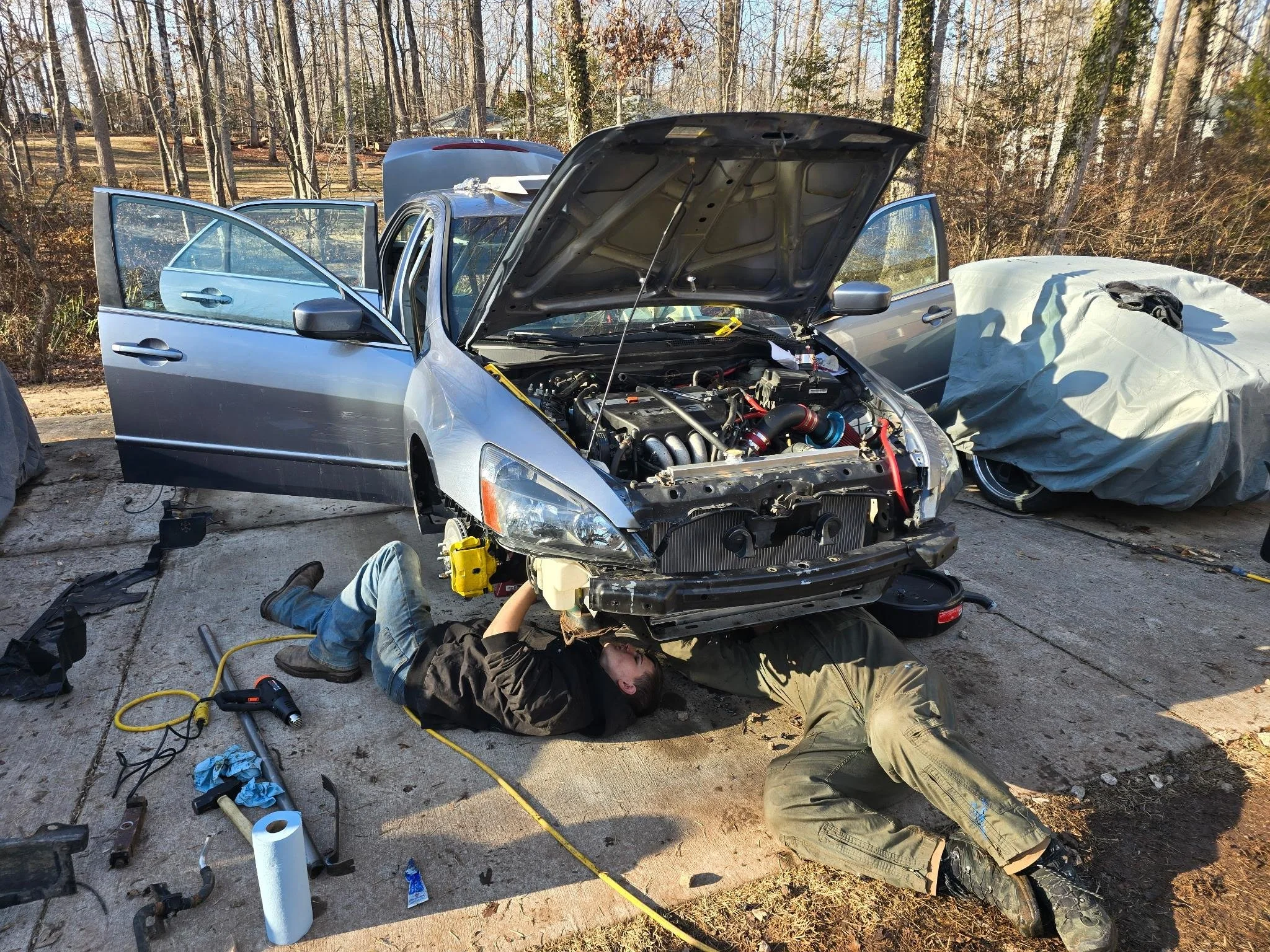
We spent a frozen weekend continuing to turn our 2007 Accord into a race car: new calipers, hubs, and coil-overs—plus a stubborn strut bolt that required an absurd amount of drilling and mild emotional bargaining. We fixed the headlights, bent the fender back, then got a Kirkey Racing seat and a “prefab” Summit roll-cage.

Cold nights and warm brakes
With snow and ice making outdoor work miserable, race prep took an unexpected turn indoors—straight into the kitchen. What followed was a low-budget automotive cooking experiment involving brake calipers, an oven, and a lot of misplaced confidence. The goal was simple: warm the metal, make the paint behave, and avoid freezing fingers. The result was bright yellow calipers, a house that briefly smelled like hot steel, and renewed faith in our progress on the Honda Accord. Questionable decisions were made, progress was achieved, and the oven lived to see another day.

Snow Removal as a Performance Upgrade
The car is free…soon it will be time to get back to work

Frozen Assets
Winter didn’t stop the build. It simply walked into the garage, stole the schedule, froze the tools, and reminded us that race prep has terms and conditions.
The plan was ambitious: make progress, turn wrenches, become faster. The reality was colder, louder, and mostly involved standing outside in the snow.
We gave it an honest attempt. There was wrenching. There was slipping. There was at least one 10mm socket that escaped across the ice with the confidence of a fugitive crossing state lines. But after twenty minutes of reduced dexterity and increased regret, we made the only rational motorsports decision available: retreat, regroup, and preserve the fingers required for future poor decisions.

Broken bolts not broken dreams
The rear coilovers went in cleanly enough to make us dangerous.
By midnight, the Accord’s back end was sitting lower, meaner, and suspiciously cooperative, which should have been the first warning. In racecar building, confidence is not a feeling—it is a trap with better lighting. Naturally, we ignored that lesson completely and moved to the front suspension like men who had learned nothing from history, physics, or Honda hardware.
That is when the passenger-side lower strut bolt made its final stand.
It did not loosen. It did not negotiate. It simply snapped, taking with it our momentum, our dignity, and several optimistic assumptions about how the evening was going to end. What followed was the traditional late-night parts hunt: dark roads, closed stores, empty bins, bad suggestions, and the growing realization that no amount of stubbornness can make the correct bolt appear on command.
So we did the mature thing, which is rare enough to deserve documentation. We stopped. We admitted the car had won the round. We retreated indoors with cold hands, wounded pride, and the ancient racer’s promise: tomorrow, this stupid thing gets fixed.

Teardown continues
By the end of the day, the Accord achieved the classic early-racecar look: partially disassembled and surrounded by people pretending this was all going according to plan.
The bumpers were off. The fender was off. The seatbelts were out. Several tools had vanished. Our hands were cold, our confidence was damp, and the car somehow looked both lighter and more capable than before.
The search for wheel hub dust covers was less successful, unless you count learning that no one in town had what we needed as a form of personal growth. Since replacement parts had apparently entered witness protection, we turned our attention back to the originals. They were battered, stubborn, and ugly, which meant they fit the spirit of the project perfectly.
This is the rhythm of endurance racing before the racing starts: remove a thing, break a clip, lose a socket, find a new problem, invent a solution, and convince yourself that every small disaster is actually progress wearing a fake mustache.
The Accord is not pretty yet. It may never be pretty in the traditional sense. But it is becoming something better: simpler, lighter, meaner, and increasingly suspicious of our intentions.

Teardown Begins
As we cataloged our archaeological discoveries, an important team decision was made. The fossilized french fries and mystery candy would not be discarded. No, those have been promoted.
Beginning this season, driver errors will carry consequences. Miss an apex? French fry. Blow a braking point? Candy. Spin the car? We'll see what else is hiding under the dashboard.
Some racing teams use data analysis, performance reviews, and structured coaching to improve driver behavior. We prefer psychological warfare conducted with decade-old snack food.
The exact rules are still being developed, mostly because our legal department is just three exhausted idiots standing around a Honda. But we are confident that nobody wants to be remembered as the driver who earned the 2009 Caramel of Shame.
Motorsports is a game of incentives. We believe we're onto something.
